“A good photograph is knowing where to stand,” Ansel Adams.
Ever since I read this quote of his, over 50+ years ago, I’ve implemented it and many of his ideas on Creative Photography. It is so ingrained in me that I can’t drive anywhere without thinking,, “Oh that’s a cool subject; what’s the best angle on it, what’s the background look like, is it best at sunset or sunrise…”. All this happens for all of 15 seconds as I speed by at 75mph!
So many aspects of photography depend on camera placement. It determines the subject’s background, what’s in the foreground, the direction of light on the subject…and ultimately the composition of the image.
These things are critical when entering photographic competitions, especially at the professional level. One of the most important criteria for a successful competition image is that it has IMPACT. I’ve learned over my 40 plus years of competition that impact is created by having a powerful center of interest against an uncluttered background (the K.I.S.S. principle). I’ve told my students it also helps if you can show the judges something they have not seen before or a familiar subject in a way they have never seen it!
My favorite impactful type of photography is Action/Sports. Anything that moves fast or quick especially motor sports, but most difficult of all has been rodeo photography. This is due to its very chaotic action and it’s always in a crappy, cluttered arena!
Rodeo Chaos, my entry into the Sports Category for PPA Imaging USA 2024, held in Louisville, KY. This image won out, in head to head, round-robin, competition over all its competitors to win the Diamond Award in the Sports Category (That’s First Place). I was one of 15 other photographers to win their categories and the $1000 prize money and trophy. Then we completed against each other for the $10,000 Grand Imaging Award that evening. I did not win the Grand Award that night, but I’ll keep trying! This is also the image that got me on the Team USA for the World Photographic Cup competition in 2024—Team USA got 2nd place that year.
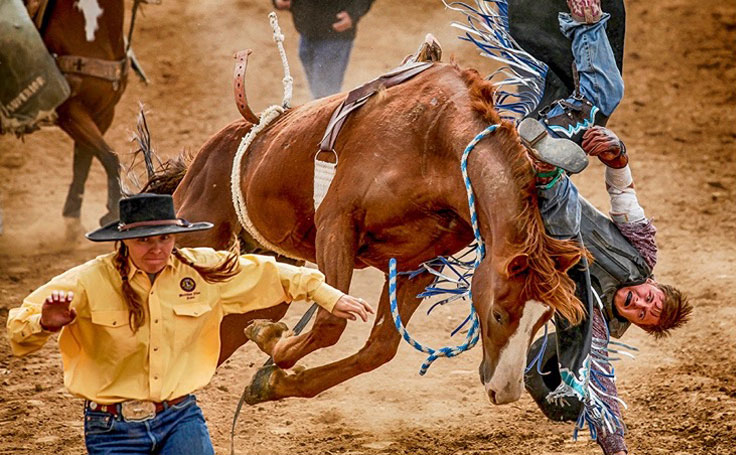
I think the reason my image did so well is that I simplified my composition, isolating my subjects, by getting rid of most of the clutter in the arena by changing my camera position from the usual inside the arena “Professional Point of View” to an Elevated Position on the second story landing of the announcer’s building. With my lens pointing down the dirt floor of the arena is now my background. A bonus was the back light that lit up the dust. This particular cowboy’s ride was so short—maybe 2 seconds—that I only got one exposure! I tend not to use high frame rates because over my 50+ years doing sports I got really good at catching peak action manually. Besides back then you could not bulk load Kodachrome 64 for your motor driven camera!
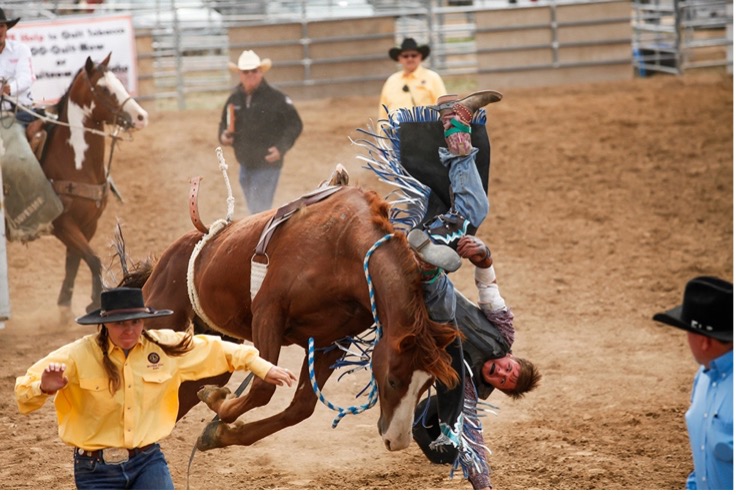
Above is the original uncropped image. You can see part of the arena in the background—it’s worse than this where the gates are that release the mounted cowboys. To the right of the frame are the 2-story bleachers filled with hundreds of people. Inside the arena is a truly horrifying place for a photographer! So, all you photographers out there, no matter what type of photography you do, think about “where to stand”, but don’t forget that camera position is not just “X” and “Y”, it’s also “Z”…Elevation!
Below is an example of using elevated camera techniques for client photography. We had planned an engagement session for a wedding client to include horseback riding on the beach. Having done a lot of beach photography I “previsualized” (There’s that Ansel Adams influence again!) an image of them riding horses in the surf, with only the ocean as a background—NO SKY. Unfortunately, his horse didn’t like the water and refused to go near it.
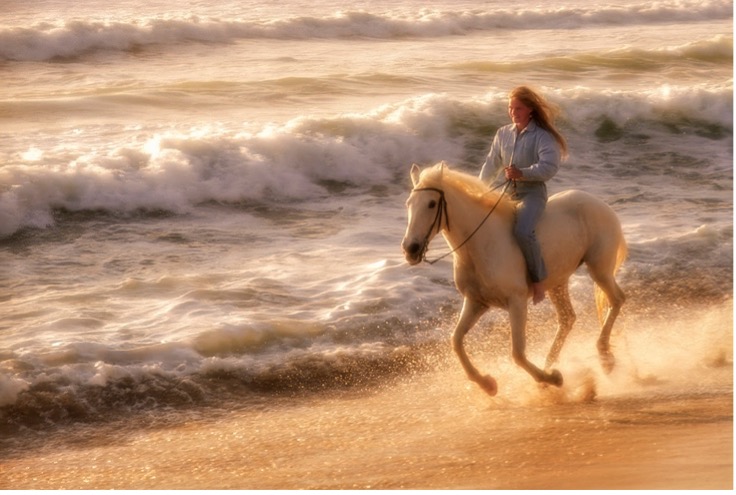
To do this I put my stepladder, on a board, on a small sand dune and panned as she galloped by me. This image become my First PPA Loan Print in 1996.