Some stories arrive quietly. Others walk right through the door and change you. This one started with a phone call.
A woman reached out after seeing my work online. She said she was the wife of Dr. Guy Fisher, and before I could ask more, she told me I was in for a surprise. I hadn’t heard of him before that day, but by the time we hung up, I couldn’t stop thinking about his story.
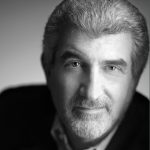
Guy Fisher had spent 36 years serving a life sentence in federal prison. During that time, he became the only inmate in the United States to earn three degrees, culminating in a Ph.D. in sociology. His life was a study in redemption, intellect, and resilience. When he was released due to health reasons, he was working on a book and needed photographs for its release.
I said yes immediately.
As with most of my client sessions, I began by doing a little research. I believe that understanding WHY you’re creating an image is every bit as important as knowing HOW you’re going to create it. Learning about my subjects, their history, their goals, and sometimes their lives, helps me craft an approach to the image that reveals, rather than hides, or distracts from who they are.
Guy and his wife were living a few towns away, and we planned the shoot at their apartment. Sessions like this are why I became a photographer. When story meets light, when purpose meets portrait, something bigger than just another photo begins to form.
A Simple Setup for a Complex Story
I decided to keep it minimal. No assistants, no entourage, no heavy kit to distract from the heart of the story. I packed only what I needed: a camera, one light, and an anxious feeling of excitement and curiosity.
When I arrived, Guy greeted me with the calm confidence of someone who has lived several lives. He carried himself with confidence and gravity, like a man who had made peace with the storms behind him. It was not what I expected at all.
We started simple, easing in with some straightforward headshots. Warming up both technically gives me the space to connect. Photography is equal parts patience and presence, the willingness to listen and then capture what you hear with your lens.
As we talked, I noticed how the light fell across his face, revealing the years that had shaped him. I wanted those details to feel honest, not dramatic or idealized, just real.
“His story was complicated. The photograph needed to be the opposite—simple, clean, and honest.”
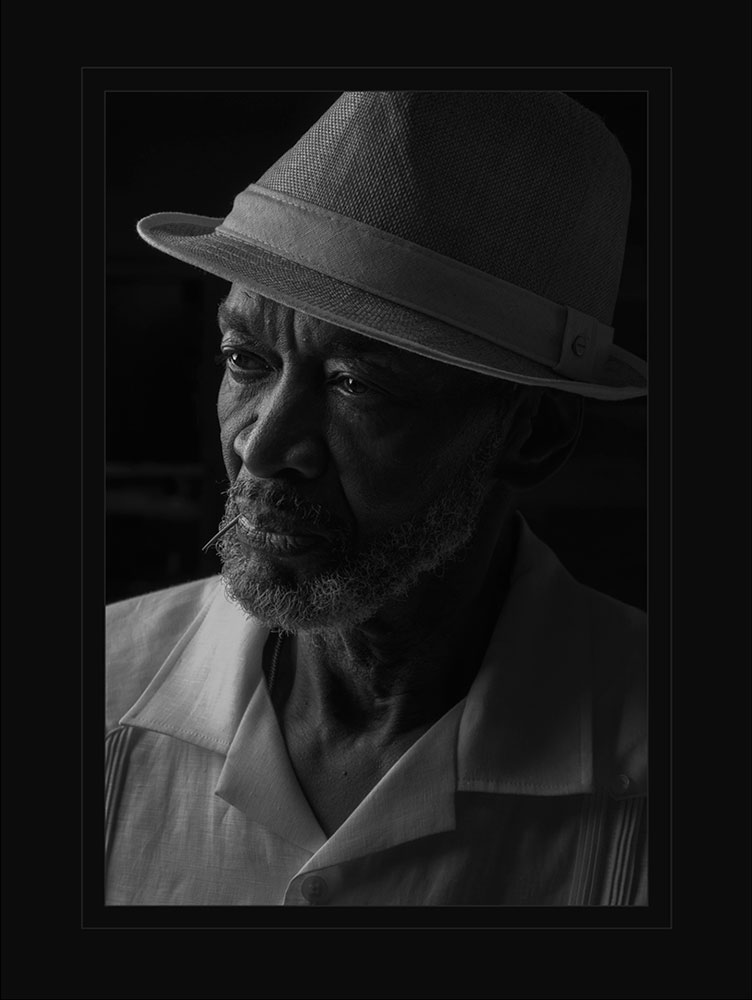
The Technical Side
The image was created with a Nikon Z7II and my favorite lens, the Nikkor 85mm f/1.8. That lens has a way of revealing texture and tone without exaggerating either.
Lighting was done with a single Godox AD600 paired with a 48-inch Glow Octa softbox, the kind with a deflector plate that gives it a character closer to a beauty dish. I placed the light almost behind him, camera left, feathered slightly forward so it skimmed his face rather than flooded it. The spill off a nearby white wall gave me just enough fill to lift the shadows gently without losing depth. If I had it my way, I would only shoot with short lighting.
Settings were intentionally unusual for a portrait:
f/13 • 1/100 sec • ISO 100
I wanted every line, every crease, every ounce of life visible. These settings gave me the contrast and depth to let the light fall off quickly, isolating him in a shadowy background.
The hat was his idea, but it was perfect, a small echo of the style he wore decades earlier, before prison, before the world changed around him. It grounded the story in both time and identity.
Emotion, Not Perfection
Photography, at its best, isn’t about perfection; it’s about empathy. When I look at this portrait, I don’t see technical or gear choices; I see a conversation frozen in time. I see a man who lived through unimaginable circumstances and came out the other side with grace and intellect intact.
That’s what the title “The Things I Had to Do” refers to, not the past he survived, but the strength it took to move forward.
Final Thoughts
This image wasn’t created for competition. It was created for a client, a man with a story worth telling. But when I submitted it, it earned an Image Excellence award, something I’m deeply proud of, not because of the merit itself, but because it means his story resonated with others.
As photographers, we spend years mastering light, shadow, and technical precision. But the real craft, the soul of photography, lies in our ability to see people as they are and tell their story without letting the gear, the numbers, or even ourselves get in the way.
And sometimes, one light, one lens, and one story are all you need.