
The Art of Storytelling by Kristy Steeves, M.Photog.M.Artist,Cr, CPP, F-ASP, APPI
Storytelling is considered the heart of powerful photography, transforming simple images into meaningful narratives that evoke emotion, context, and connection. While technical skills, like figuring out the right camera settings, composition, and light direction are essential, there are other important elements needed, such as “voice”, “emotion”, and “point of view”, to take an image to a higher level.
What is storytelling? Simply put, it’s an art. It’s not a process, method or technique. It requires vision, creativity, skill, emotion, and practice. Storytelling isn’t something you can grasp in one sitting; after one course, but rather, a trial-and-error process leading to mastery.
It can seem quite daunting to a photographer who decides to embark on the journey of becoming a visual storyteller. Consider this: a book author has on average between 200-400 pages to tell a narrative. That’s somewhere between 50,000 and 100,000 words. An average movie is 90 minutes. There are 24 frames per second. That means a director has 129,600 frames to build a complete story from beginning to end. The challenge for the still photographer is that we have only one frame to tell our stories.
The art of storytelling starts with the understanding that there is a difference between taking a client headshot versus telling a story. Take these images for instance.
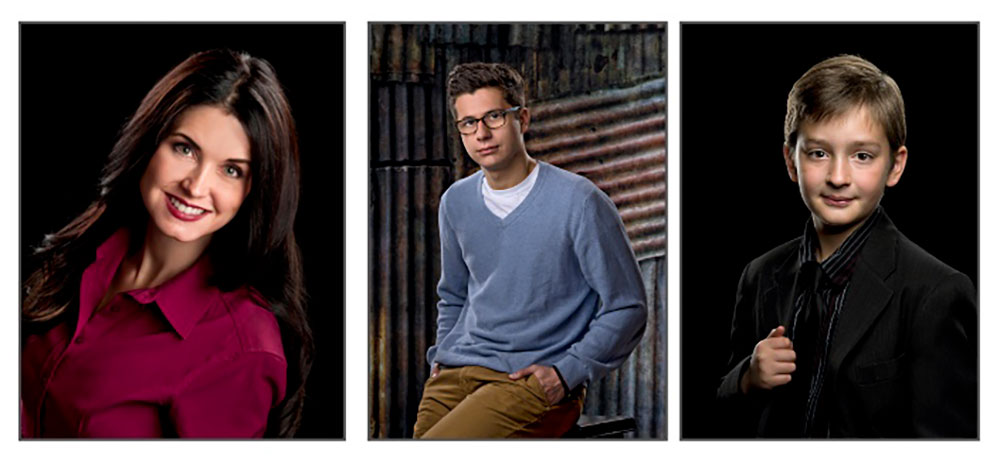
They are what some people might call “superficial” images. A picture without a story is just that: a superficial picture. Without a story, the photography has no depth, no personal meaning, no emotion. An image with a story is the catalyst in triggering a chain reaction of emotions making it memorable, iconic, and impactful.
So how do we go from taking superficial photos to impactful storytelling images? Let me share what I learned many years ago as a former broadcast journalist; something that I use today as a photographer. In college, journalism students are taught “The Six Ws”: Who, What, When, Where, How, and Why. These storytelling guidelines are used in journalism, police investigations, and research. Every day, for 25 years, when I was out covering news events for a Cleveland, Ohio television station, I made sure I focused on the Six Ws when I asked questions so I could accurately tell a good story.
As photographers, we can ask the same questions before embarking on a visual storytelling session: Who am I photographing? What is the story I want to tell about my client or model? Whenis the setting (present day, future, or the past? Where will the session take place? How will I execute my idea? And Why am I telling this story?
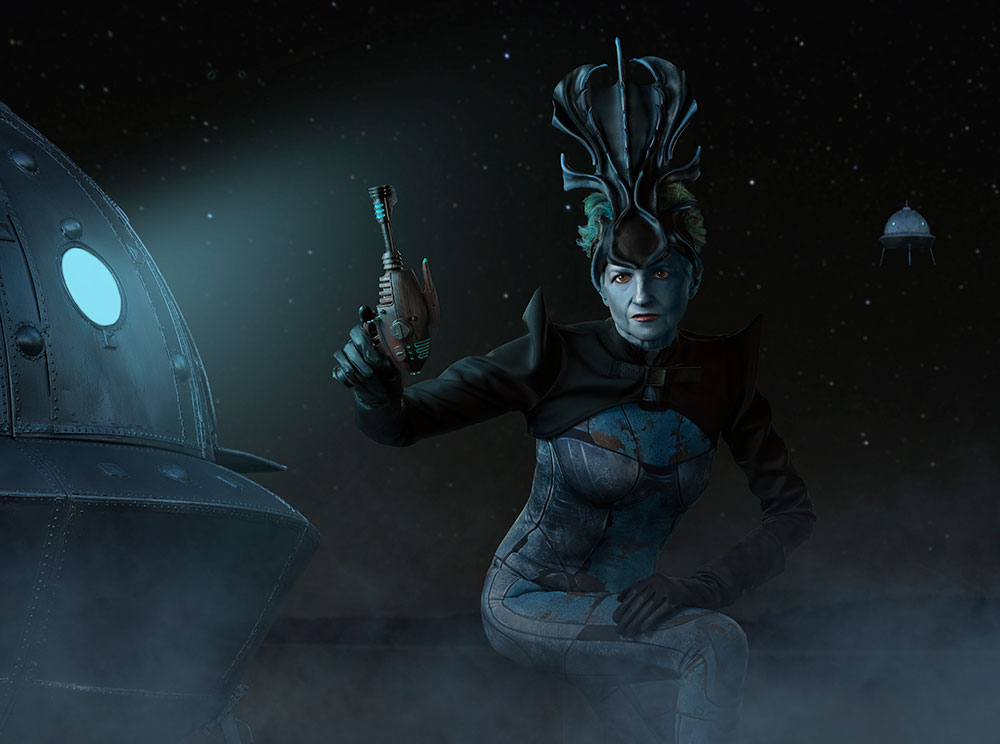
Here is an example:
Who am I photographing? Ella Carlson – a photographer from Massachusetts. What is the story? Ella has a fascination with aliens so my goal: turn her into an extraterrestrial being. When? Current day. Where? Outdoors at night. How will I execute my storytelling idea? I will photograph Ella in my studio as an alien. And believe it or not, there is actually a spaceship located in my town of Medina, Ohio that I will use as part of my storytelling concept. I will then composite the two together with a third element: a night sky that I captured a couple years earlier while in Canada.
Why do I want to create this story? Because I want to highlight the fact that Ella created a whole album of aliens and entered them in image competition. Her unique work earned her a 1st place Grand Imaging award at the International Photographic Competition with Professional Photographers of America. I wanted to tell her story as an alien aficionado, and to do so, I even hired a professional movie make-up artist to help Ella look the part.
Here’s another storytelling example of a maternity session:
I like humor and this pregnant woman, Serena Cox, was game to do something fun.
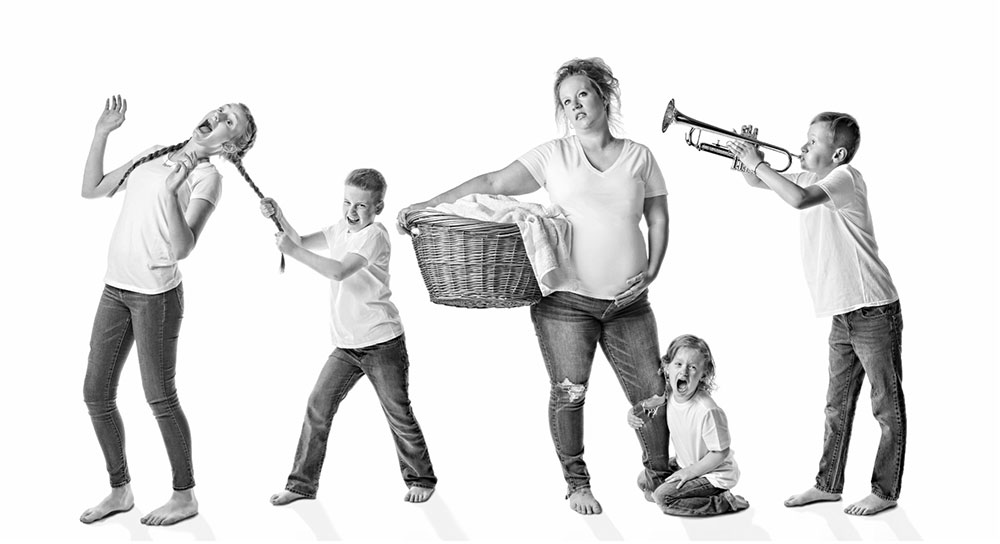
Here’s how I used the Six Ws to figure out what we would do to tell her story. Who? Pregnant mom (client). What is my idea? Include her 4 children, who are driving her nuts, into the story. Her thought process: “What was I thinking having another child?” When? The present time. Where? My studio. How will I execute my idea? High key lighting and high key background. Why? To tell a humorous, impactful story about Serena and her children.
Before our session I shared my idea with mom. I asked if any of the children play a musical instrument. I wanted her daughter to wear braids so her younger brother could pull on her hair. Can everyone wear white t-shirts and jeans? I provided the laundry basket and towels for the session. Mom loved this maternity image so much, because of the storytelling aspect involving her children, that she ordered a large print to hang on a wall in their house. Would a superficial picture of just mom by herself have resulted in such a large print order? Probably not. And would she have the same emotional attachment to it without all of her children in it? Probably not.
And here’s another example of a superficial client image – a business portrait – versus a storytelling image. Which one do you think this veterinarian prefers? Which one captures her personality and her enthusiastic love of animals the best? Which one is more appealing to pet owners who might be checking out her business website?
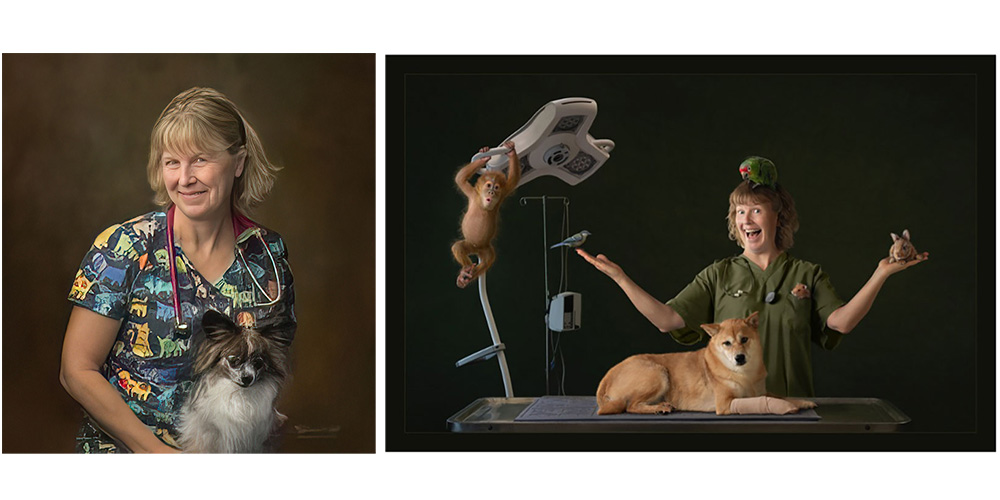
I did the Six Ws before photographing Dr. Lisa Carpenter, who’s from Minnesota, and came up with this idea before she even stepped foot in my studio. Who: a veterinarian. What: a Doctor Doolittle theme. When: present day. Where: I went to a nearby vet clinic and photographed the surgery room before we did the portrait session. I asked Lisa to bring her scrubs, stethoscope, and bandages to my studio and arranged for a dog model to be photographed with her.
Oh, and I had a cute little hamster that we put in the pocket of her scrubs. I then composited everything together– along with stock photos of a baby orangutan, bunny, and bird – to create the overall image. Why? I wanted to give Lisa a great storytelling image with emotion and impact. Plus, an added benefit for me was that I entered the Doctor Doolittle image in a national competition, and did well with it.
Cecil B. DeMille, an American filmmaker and actor, once said “The greatest art in the world is the art of storytelling.” As photographers, we possess the power to move, motivate, and inspire others, as well as create empathy and shared experiences by freezing fleeting moments in a single frame. We act as visual narrators, making viewers feel, think, and engage with the subject on a deep level. That’s why we need to let the image speak and to give it a voice. Just like a good book or film that gets you emotionally invested in its characters photographers can do the same with their images.

















No Comments
Leave a comment Cancel