
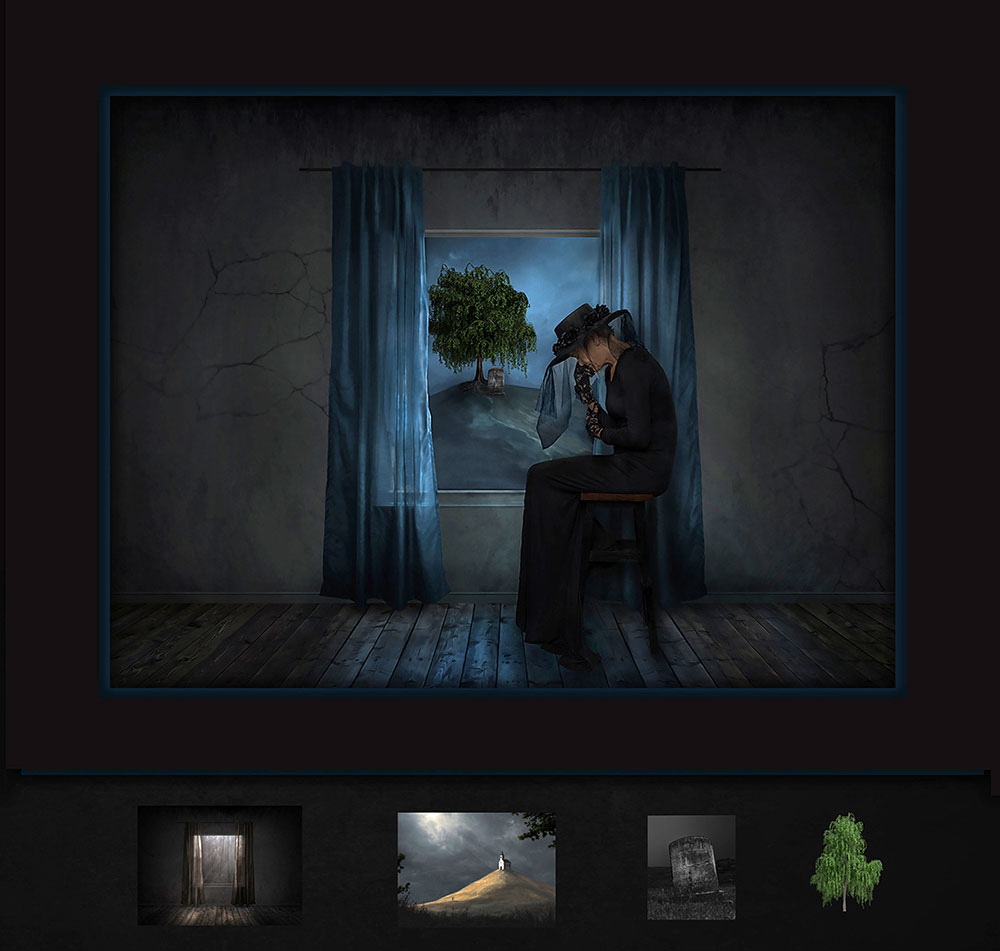
The Story Behind my Weeping Widow Portrait can come from inspiration or imagination. The drive to create can come from many different places. When I set out to create Weeping Widow, it came from both. Though designed specifically for competition, it was inspired by very personal experiences of watching my mother pick up the pieces after her second divorce. Not simply the loss of a marriage, but the loss of herself within that marriage.
Because sometimes grief looks like loss…but it doesn’t always come from death. Sometimes grief comes from watching your entire world crumble — watching something you loved and built your life around fall apart. Over time, you change. We change. Sometimes we change to fit those we love. We accept and lose pieces of ourselves in hopes of becoming something that makes someone else happy. But what happens when that person is gone? When you’re left to pick up those pieces, but they don’t seem to fit who you are anymore?
When I sat down to conceptualize this image, I knew I didn’t want just another sad-looking photograph. I wanted to create something with a basis in reality. I wanted my viewers to feel what I felt when thinking about that grief. Losing a part of you never feels poetic. It feels messy. So I began building an idea around that feeling. What would a photograph of messy look like? The concept of a woman grieving lost love came to mind. Not the loss of a spouse, but the loss of herself within that relationship. Her normal. Her life.
I started visualizing her posture, how that grief would weigh her shoulders down and break her in half. I imagined her head bowed in sadness, her body folded into itself. I wanted every element of this image to have purpose. The window symbolizes a divide—between her past and present, inside and out, what is and what could no longer be. The veil serves as a juxtaposition between bride and widow. She’s neither but her grief lives in that space between losing hope and what was once promised to her.
I directed her posture to further communicate that weight. Her shoulders and head pulled downward, gently collapsing into itself. And of course…the weeping willow. When thinking of trees to use for the background, I instantly thought of the weeping willow. Historically, it symbolizes sorrow, grief, and reflection. But if you really look at the way it flows, it mimics my subject. From the downward draping of the branches to the softness of the leaves. It was too perfect. The ‘weeping widow’ leaning against the ‘weeping willow.’ Literally and metaphorically cresting down.
Creating the emotion was only half the battle. In order for an image like this to sell the concept, the technical execution had to be flawless. Weeping Widow is a composite image, built from multiple individual shots and married together to create one seamless final photograph. The base image of my subject was photographed in-studio. Camera of choice was my Canon R6 with a 24–70mm f/2.8 lens. A versatile lens with enough reach to capture sharp details, but flexible enough to maintain the look I wanted.
Camera Settings: Camera: Canon R6 Lens: 24–70mm f/2.8 Aperture: f/5.6 ISO: 100 Shutter Speed: 200 Lighting: Geekoto GT400 (https://shop.geekoto.com/collections/off-camera-flash/products/geekoto-gt400) GEEK MOD Y36 Lantern (https://shop.geekoto.com/collections/modifiers/products/geek-mod-y36-lantern)
My lighting for this image was soft, yet directional. I wanted enough light to sculpt her, but subtle enough to keep the overall look and feel painterly and minimal. There was purpose behind every little detail, down to the light itself. Lastly, I pulled in images for the window foreground, landscape, and tree to layer in post-production. Once I had all of my assets, it was time for the fun (and sometimes daunting) part— editing.
Photoshop allowed me to place my subject into the window frame, drop in the outside landscape and add the tree for finishing touches. The key to making sure the image didn’t look like a stacked photo was ensuring my light matched from my scene and maintaining a consistent perspective. I also did a heavy handed color grade to bring out more of the cooler tones.
“My goal was to create an image that pulled people in to feel something, not study how it was done.”
I was thrilled Weeping Widow earned an Imaging Excellence (IE) award through PPA’s annual Merit Image Review. Not only was it rewarding to have the technical aspects of my craft recognized but to know that the emotions I put into this image were felt by others as well.
There is something incredibly powerful about creating with meaning. As photographers we have the unique opportunity to document life. But we also have the power to interpret it. We can translate feelings into something visual and share experiences that may not always have words.
Weeping Widow is my representation of heartbreak. The kind that doesn’t come with death, but with loss of self and the struggle to find yourself again. It’s something I think a lot of people can relate to. Although divorce was the initial inspiration, it can translate to more than just the loss of a relationship. It could be the loss of a parent. Best friend. Job. Whatever it is, we’ve all had something ‘ripped’ from our lives that we had to learn to live without. But we take pieces of those things with us— whether it be lessons learned or even scars. That’s part of life, too.
This image challenged me in more ways than one. As I mentioned earlier, it was my first ever image I submitted into competition and exceeded my expectations on multiple levels. It challenged me to not only create something creatively, but to tell a story I actually cared about.
Typically when creating for my portfolio I shoot with a certain outcome in mind. Something that will wow viewers. Something that I think will catch the attention of a judge. But this shot taught me something I think we all forget as photographers. At the end of the day we create because we have a story to tell. Whether that story is for a client, your portfolio, or a photo competition doesn’t matter. Create from a place of meaning and your final photograph will not only be better, but resonate with those who view it as well.
See more of Mandy’s incredible work here.

















No Comments
Leave a comment Cancel